Saturday, December 19, 2009

December 19

We were right about last week's rain forecast - our desert site only had about an inch of rain compared to the 7 to 8 inches the forecasters predicted for the past week. When I got to the site this AM the other crew pouring cement for the other four, not three observatories - my mistake, were already at work. During the course of the day they brought in five trucks with a total of thirty-six cubic yards of cement.

Pouring the slabs down the hill from us.

By the time John showed up I had already laid out the four hundred feet of hose and set up the cement mixer. We spent a bit more time taking the tarps off the footings and once again vacuuming out the two footings holes - probably twenty pounds of loose material that blew in over the last two weeks.

Once we started we realized several things. The cement mixer was Chinese and it did work - barely. Once we dumped the water and three bags of Quikrete in and started mixing, we found that the baffles in the mixer were not well designed and did not mix the material in the bottom of the mixer. We had to stop every few minutes and hand mix the bottom stuff to get it uniform. I should have known with my previous experience with Chinese equipment that they are barely functional if they work at all - you get exactly what you pay for.

We also realized that because of the height of the top of the mixer that only I could load the 60 pound bags of Quikrete into the mixer - I had to lift the bag almost to shoulder height and then flip it over and onto the top of the mixer. We got through the first twelve bags, or 720 pounds of cement, pretty quick with me mixing, John and I sharing the transport to the footing holes by wheel barrel. Then John shoveled the cement into the footings and his wife worked the cement to fill in vacant pockets, all while I mixed another load.

Then we found out that the gods approved of our light hearted acceptance of their trick upon us the other week. The club contractor, who was directing the pours for the other observatories, came over and said that they were finished and did we want the remaining cement for nothing - about a cubic yard by his estimation. We of course said yes and the last cement truck pulled as far up our driveway as possible. The cement was dumped into our wheel barrel and we wheeled it over to our work area. We got a total of eight wheel barrels out of the truck and that turned out to be a bit more than we needed.
John taking a barrel of cement from the truck.

This was great! What we figured to be an all day job finished by noon. Of course now we have 48 remaining bags (1.4 TONS) of Quikrete that we have no current plans for but we do have some future plans. We are thinking of building a totally enclosed BBQ pit off the south side of the observatory. Also, we are thinking of building a pad for visual observing off of our south-east corner; it would include a small shed that would roll on rails set into the pad and would house my sixteen inch Dob reflector that has been mothballed for the last five years.

John and his wife working on the initial smoothing after the pour was complete on the west footing.

Close-up of the east footing completed and starting to cure. You can see the cement deep in the main hole. We may decide to add more cement there instead of entirely using back fill. The scratches in the surface are to provide a rough surface for the grout that will top off the footing.

John rough smoothing the surface of the west footing.


Today was the first time that we finished a days' work ahead of schedule so after we had lunch and basked in the 70 degree sunny weather for awhile, we walked around the site to see the other pads that were poured today. Tonight is the club's monthly star party so there were quite a few people starting to show up by mid-afternoon. One of the old timers said that today saw more construction at our site than has ever occurred previously in a single day.

Here I am having my turn to mug for the camera after the pour was completed.

While walking around the entire site, we came upon a view of our observatory site from an angle I haven't shown in this blog before. The picture below is from the southeast:
You may be able to tell that our whole site is on a small leveled area on a hillside about ten feet above the lower surrounding area. On the left in front of the observatory are the steel bars that we refurbished last summer. The sunlit side of the observatory is the south wall. You can see that there is no longer any structure remaining on top of the walls that was to support the originally planned dome. John's pop-up camper is to the right on the driveway. Behind the camper is the PVC frame for a large tent to cover our vehicles if we want - we haven't used it yet. The ridgeline is about fifty yards beyond the observatory to the north.

Here are two of the new slabs poured today. They are the ones from the first picture that showed the cement truck at work.
Notice the two open rectangles in each slab. Each one is the site of where a cement pier for a telescope will be placed. These observatories will be of simple stick construction and are much smaller than our observatory so they will probably be completed by February while we will continue to work until summer.
Our next plans are for John and I to work independently for a month or so. He will start on the heavy fabrication work for the rail system and the roof trusses at home. I will be working on removing the warm room window, rewiring the building, and replacing the hanging roof panels and lighting system.

Saturday, December 12, 2009

December 5

John and I got out this day with the hope of pouring at least one footing. However, when we looked at the rebar and form construction, both had shifted slightly within the footing holes. The culprit was that several connection points of rebar were held together with the stiff wire that is often used. Apparently, us amateurs did not secure them tightly enough and our footings were slightly off. So we pulled the rebar out of the footing hole and John proceeded to weld every joint that had previously only been wired together. John welding the final joints. There is another grid layer of rebar still in each hole that is not attached to the pier support John is working with.

Remember that we are trying to get the top of the footings and the base of the rail support accurately positioned to within 1/16 of an inch and perfectly leveled with the back of the building five feet away. We actually spent the rest of the day completing that task. We probably would make a good comedy team for a construction gang. We eventually did get everything placed properly and solidly. Here's a couple of pics of the completed footing construction:
This is the west pier. The hammer in the foreground can give a sense of scale. The two steel horizontal beams are temporary and are used to position the frame level in the east-west direction. The two large clamps are also temporary to position the frame level in the north-south direction. The top of the large frame and the wood square are set level with a spot on the north face of the observatory using a laser level. When the cement has set, the wood square on top will be removed. The four bolts it is holding in place will attach to the bottom of the pier supports. The large wood frame will also be unscrewed and removed. The remaiing part of the pit will be backfilled to ground level.


In the above photo you can see down into the excavation pit of the east footing. The pit is 18 inches deep and approximately 3 1/2 feet on a side. There is a rebar grid about 4 inches off the bottom. The entire bottom of the pit will be filled to eight inches of cement covering the bottom rebar grid as well as the second rebar grid that is welded to the vertical rebar. This bottom part of the cement footing will end at the bottom of the large square wood mold. More cement will be poured into the center of the wood mold to the top of the mold and the bottom of the square plate. If you look close at the bottom of the upper right part of the pit you may be able to see a new friend of ours - a 2 inch long stink bug that didn't seem to mind the 40 degree temps all day.

While we were out there another construction team showed up to begin work on preparing the molds for the cement slabs for three more observatories. Here's a shot of them at work excavating and taken from the front of our observatory: They are working under the supervision of a club member who is a contractor. They plan to pour all three slabs on 12/19. Here is the supreme irony that the gods are treating us to. John and I have slaved pretty hard to haul in sixty bags of 60 pound Quikrete - read: 1.8 TONS - to our site and assembled our own portable cement mixer. Why? Because no cement business would come out to our site to pour such a small amount of work - we're five miles up a dirt road from the nearest paved road. We were originally invited and briefly considered joining up with the cement pour for the three new observatories but opted out because they did not plan to pour until spring and that didn't fit our schedule. As of now, we have gone slower and they have gone faster and guess what? On 12/19 when they have the cement truck in to pour the three slabs, we will be mixing our own small pour for our two footings. We could have the truck add a bit more to their mix and pour for us but that meant that we would have to haul out the 60 bags we already have on site.

The gods must be smiling!

On top of that ironic frustration, the weather was mostly overcast, windy, and temps stayed in the lower 40s. The picture below is of an unsual cloud formation called "lenticular". It occurs when strong, straight line winds blow consistently over an elevated area, such as a mountain. In this case this cloud is above the 7,000 foot San Jacinto Mountains on the west side of Palm Springs, about 25 miles to our east.


Below is another shot taken later in the day of a lenticular pancake - several lenticular clouds piled one on top of the other and pretty rare. I have seen that only once before and that was when we lived in New York and that occurred over the Catskills. On the bottom right you can see a water hose snaking off into the distance. That is a 400 foot long set of hoses that I have laid down the last three times we have been working in anticipation of mixing cement.

As we left we were concerned about the weather forecast thru 12/14. According to the So Cal super duper weather men who call a light drizzle a "torrential mist" and interrupt TV programs to warn of an incoming dew front, the desert could get as much as 7 inches of rain from 12/6 thru 12/14. Our estimation that they have their decimal point wrong in the forecast is holding as of today, 12/12 - there has been barely one inch of rain at our desert site.

We will be out there on 12/19, hopefully pouring at least one of the footings. That will end our work for the year.

Here's a fun picture I took from home on Tuesday morning after the first storm cleared out; that's the one that dropped so much snow over so much of the country this past week. This is looking east up my street at the rising sun. Prominent are the crespuscular rays from sunlight piercing through holes in the clouds.


Tuesday, November 24, 2009

November 24

Its been a frustrating several weeks in progressing with the observatory, mostly due to family events with both our families, plus frustration with the weather - yup, there is weather in California. So there are no photos in this post, just an update - or a downdate, take your pick

Based on the current wiring diagram of the observatory, I've been working on a a rewiring plan as far a possible but haven't really progressed into it yet.

After the last post, John and I decided that the 14 inch depth to our footings were too shallow, despite it being in almost completely solid rock. This past Saturday I spent almost 8 hours with a jack hammer and shovel completing the excavation of both holes down to 18 inches and also widening them to 3 X 3 1/2 feet. After all, we will be sliding a 4,000 pound on wheels over the north end of the building by almost six feet - better safe than sorry. John came out midday and assembled a new 3 1/2 bag cement mixer that a friend of his loaned us for the duration. I left in the evening but John stayed thru Tuesday. I returned on Monday and left with John noon Tuesday.

Weather-wise, Monday was the worst day we have spent there during construction, even worse than the 110+ heat we suffered through in the summer. This time it was the wind - a cold Santa Ana. It blew from Sunday until we left early today, maintaining a constant 20 mph and gusting to 30 mph. What is most difficult to deal with is the fine desert dust that gets entrained in the wind. We spent 8 hours Monday assembling the rebar that John previously cut. We had planned to install and properly align the rebar and post assembly for both footings plus mix and pour the cement (~60 bags of 60 pounds each). We must have had a few too many when we set that goal. Durign all this work the wind was so loud that we could barely hear each other shouting more than twenty feet apart.

By dark on Monday we had welded together one rebar frame and accurately placed it. We needed it to be level with a point on the observatory wall 5 feet away and square with its corner with an accuracy of 1/16 inch. The second rebar frame we assembled but only approximately placed. All day we kept vacuuming the blown dust out of each footing hole. We had dust in our eyes running in muddy rivulets down our cheeks, up our noses, and even inside our clothes pockets. We stopped at sunset with the wind picking up even more. I slept in the club bunkhouse where I took a hot shower and had to turn the heat up to 85 to keep from shivering. John tried to sleep in his pop-up camper but the canvas walls blew out during the night and he ended up in the bunkhouse too.

This morning the wind and dust were blowing and pounding so hard on the bunkhouse that it woke us up and it sounded like a hailstorm. After a few hours it let up and we checked the observatory site. The footings were almost half filled in with dust. We decided to lick our wounds and called it a day. We'll be back next week. The plan now is to complete the welding and accurate positioning of the second rebar frame and then come back another day and mix and pour the cement. Fortunately we both had parked our cars on the lee side of the osbervatory or the bunkhouse so we didn't have the paint stripped off our cars. I have seen that happen to people several times.

The other item we wanted to complete before Thanksgiving was the outside painting. However, we may be stuck until spring. The infrared reflecting additive we will add to the paint needs to set for at least 24 hours at temperatures above 55 degrees. Other users have told us that they have had problems with the paint flaking off over the coruse of a year when the temperature fell below 55 during the setting period. Our night temps in the desert in the winter are always flirting with 55 at best and frequently its cold enough to get snow accumulations.

Our original goal was to have the observatory roof built and completed by Thanksgiving. That's now revised to Memorial Day.

Saturday, October 17, 2009

October 16 - 17

I just completed my first overnight at Anza in quite a while. My plan was to stay from Friday afternoon until Sunday morning. I had two objectives: finish the excavation with John of the second footing for the pier that will support the rails that extend beyond the north end of the observatory and, at night, shake down my new imaging equipment configuration.

I got there about 1 PM with another beautiful day there - temps in the low 90s, very low humidity (less than 10%), light breeze, and a very dark blue sky without a single cloud. John showed up about an hour later and we got the excavation down to about half a foot in two hours. The slow progress was due once again to using a jack hammer to break up the solid rock a few inches below the surface soil. By 4 PM we stopped to wash up and get our equipment set up for a night of imaging or, in my case, equipment shake down.

This was the first time I set up in the new observatory; John set up on his observing pad about 30 yards away. An observing pad is simply a 12 foot by 12 foot concrete slab supplied with electricity, and sometimes a permanent mount aligned with the North Pole. John will be selling the lease to his pad when the observatory is completed, as will I.

I set up all my equipment before it got dark. The night became very dark with the Milky Way being visible from Sagittarius in the south all the way through Cassiopeia in the northeast. One way of quantitatively measuring how dark the sky is is by using a portable photometer called a Sky Quality Meter. It measures how bright the dark part of the sky is directly overhead. The higher the number, the darker the sky plus the scale is logarithmic rather than linear. If you live in a city and can see only a few stars, your reading would be no higher than about 17. If you can just barely make out the Milky Way when its overhead, your number is probably about 19. That's what it is at my house. The darkest measured anywhere on earth is about 23. That's 4 numbers different than at my house but is actually about 40 times darker. A difference of as little as 0.3 can be very easily apparent to the naked eye. Friday night at Anza, that number was 21. Visually, I already mentioned how bright the Milky Way was. There were easily several thousand stars visible and some of the brighter and larger objects were naked eye visible.

With my equipment I had to get several different systems working. With the equatorial mount, a Losmandy G-11, I needed to learn the procedure to align it with the North Pole. This is necessary so that I can take long exposure photos of the sky and not have the stars streak on the image as the earth turns. I needed to get it accurate to within less than 10 minutes of arc - that's less than 1/3 the diameter of the full moon. Surprisingly that was done pretty quickly. The next part was to get the auto guider system to work. That is made up of a small refractor telescope piggybacked on my main telescope, with a small camera that is linked to a program on my laptop computer as well as the G-11 mount. What this system actually does is to take a picture of a specific star every 2 seconds, the software then determines how much it has moved over the two seconds, and then signals the telescope mount to correct its movement to accommodate the change. This is necessary because all telescope mounts have some inherent variability that needs to be reduced as far as possible to have pinpoint stars when you image. In this case I got the software to talk to the camera but it could not recognize the mount. That's something to work on for next time. My main system I use for imaging is a refractor with a 4 inch diameter lens and an old Canon Rebel DSLR camera that has been modified. Another software program will tell the DSLR to take a picture, how long to expose it for, whether to store the image on the camera chip or download to the laptop, and how long to wait between taking pictures, and how many pictures to take. Typically, for one object I will take 60 pictures of 3 minutes each, separated by 12 seconds (the time necessary to transfer the image to the camera chip. In this case the software would not operate the camera as had been advertised so I need to find the correct drivers on the Internet. As a result, I was pretty much done by about 10:30 PM that night with no hope of imaging on Saturday night.

Fortunately a couple of other members came by about that time with a bottle of wine and several cups. I could tell that they must have left an empty bottle somewhere on their journey over to me. They hung around until the bottle was empty and moved on. I actually went to sleep in the warm room shortly thereafter. John has his telescope imaging set up perfected. He sets up by sunset, programs it for the entire night, and then either goes around socializing, visually observing, or going to sleep.

I have found that one rarely sleeps much past sunrise in the desert. John came over and we drove ten miles into Anza for breakfast. Good food, not expensive, and lots of the locals from 80 year old cowboys to the native Cahuilla Indians.

We got back and started on that second hole again, finally finishing it by 1 PM. At that point we decided to map our electrical circuits in the observatory. We have 4 fifteen amp circuit breakers and figured out what circuit currently powers what outlet or light. By about 2 PM I decided to call it a day and head home since I was unable to image Saturday night.

Regarding the observatory, we have several options for the next steps:
1 - John will fabricate a rebar assembly for the two pier footings. Then we will get a 2 bag cement mixer and the necessary cement mix.
2 - I'll get 10 gallons of outdoor paint and mix it with the special additive I found. Its a NASA-developed infrared blocker to be mixed with paint. It blocks 99% of the infrared radiation longer than 1 nanometer. That will deflect most of the heat energy from sunlight and keep the observatory walls cooler during the day so it will not adversely affect our imaging at night. We decided it will be easier to use a roller with this material rather than the power sprayer we were considering.
3 - We will re-design the electrical system as far as possible to meet our needs which are a bit different than the original owners. Once we complete the design, I'll do the re-wiring.
If we go with the pier footings first, we will probably follow that up with the roof fabrication and hold off on 2 and 3 above.

Since I'll be having knee surgery this Wednesday, it will probably be a couple of weeks before I am out there working again.

Monday, October 5, 2009

October 2

After several memorable family events over the last month I made it back to the observatory this past weekend. Although I have been AWOL my friend John was busily working several weekends. He worked on continuing the demolition of the old dome supports, cleared brush for a further twenty feet north of the building, and completed fabricating and installing most of the stairs leading up to the observing area and completed the outside grouting project.
Stairs are completed except for the bottom floor platform.

The day was gorgeous - I think I know why people live there despite the amazing heat of June thru August - the rest of the year is terrific. Saturday was terrific - bright blue sky, 75 degrees, low humidity, and a light cool breeze.

Saturday also marked a milestone - the final demolition was 99% completed with the removal of the last roof eave from the warm room roof. The remaining 1% are the two top plates on the east and west walls which will stay in place until we are actually ready to install the steel rail structure.

Dropped eave on the left next to our debris pile.

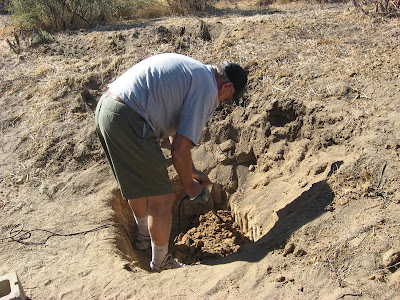
Most of the eight hours we worked involved excavation. We have two post holes to dig to support the two posts that will support the rail system that will extend to the north of the building for five feet. As can be seen from the photo below where John has just started to dig below grade after excavating the loose soil, there is a steep five foot slope immediately behind the north wall that we had to excavate through just to get to the observatory floor level. Based on the loose soil that made up the slope we removed, the plan was to dig footings three feet across and up to two feet deep.

John using the jack hammer as he digs below grade

However, once we dug down to grade, the loose soil ended and we reached what is commonly called "desert pavement" - fine grains of rock that have gradually glued together with "desert varnish" over a long period of time. Not even a pick helped to break up this stuff. Fortunately, we had a small jack hammer that we used extensively. John used the jack hammer to break up a few inches of the rock, then I cleared out the loosened rock. Back and forth for hours. By the end of the day we ended up excavating about 15 inches with one hole. Since we were going into solid rock, we decided 15 inches was deep enough for the footing.

Tom using a small jack hammer in hole

We called it a day at that point. Below you can see the near hole only;y had the slope cleared down to grade while the further hole is full excavated. Notice below that we threw much of the cleared rock on top of the slope to serve as a berm to direct any water flow away from the observatory.

The holes don't look like anything much but that was almost 8 hours work by two people with a power tool. Our next step is to complete the second hole next weekend. After that we will either proceed with pouring the footings and erecting the support posts or spray painting the observatory exterior.

Saturday, August 29, 2009

August 29

After hearing about heat warnings thru Sunday and the temp hitting 116 at Anza yesterday (Friday), I was ready for another day like several weeks ago. Fortunately, that didn't happen while I was there. I arrived early to get as much done before it got really hot although it already felt like it was in the low 90s. The warm room seems to be pretty well insulated because the temp inside couldn't have been above 75 when I arrived. I got set up with my 4 gallons of paint to complete the day's objective: finish the first coat on the half of the room that I didn't complete last week and apply a second coat to the entire room. I looked around for our little pet lizard - just a local resident about 7 inches long that wouldn't leave when we started to clean the place up. Usually it is on the walls but I didn't see it anywhere. I started up the heavy duty fan we have and then I found where he was. We'll have to find another local lizard.

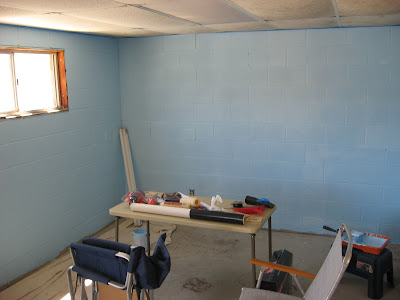
I was painting by 8:30 AM. Completing the first coat went pretty smoothly and took less than an hour. I drank my pint of water every 20 minutes. Pretty soon the room was as hot as outside since the fan was running to help dry the paint quicker. The second coat went on much easier and quicker than the first. I was done by Noon! I left at that time with the temp climbing past 102 and hitting 112 later in the afternoon. Fortunately, it looks like no additional coats will be necessary although I do have to paint the inch or so of wall down by the floor. The next indoor painting will be when we build the divider to make two separate rooms but that may not occur until after the roof is on.

Second coat looks good. The ceiling panels that need replacing can also be seen.


Looking toward the front door and the electrical panel.

John worked at home today. Last week he took home some small pieces of steel to fabricate the short set of stairs we need going to the observing room.
Instead of four very steep temporary stairs, we will build a permanent steel stair way. The first step will actually be a landing at the observatory door. That will allow us to build three steps instead of four in the same space. The treads will be a nice 11 inches wide instead of the 5 inches shown here.

Here are some additional things we have done or need to complete in the next several weeks. Here are the completed steel we recovered from the debris pile.

More steel will need to be purchased but this was a great start and an unexpected cost saving.

This is one of four heavy braces that helped support the old rail structure. Four of these braces will be removed in the coming weeks.

The south wall is clean from the power washing .The dark marks are the experimental grout filling that John used. It looks successful and John will fill in the remaining eroded areas that can be seen over the next week or so. Hopefully I will power paint the exterior in the next two weeks.

The blue ridge in the distance is Palomar Mountain, about 12 miles away. Just beyond and below the ridge line is Palomar Observatory.

Friday, August 28, 2009

August 23

Now that the warm room walls were cleaned, I came out on this Sunday to begin painting them. John had been out since Thursday evening doing his imaging as well as working around the observatory. He got quite a bit done. Even after removing the circular steel rail two weeks ago there still was a lot of rail support stuff on top of the wall that needed to be pulled down. John took care of that before I arrived, leaving only a 2X6 cap board on top of the east and west walls that will remain there until we’re ready to set comparable steel beams in their place. After three days he was pretty beat and headed home just as I started to paint.

We’re using a very light blue semi-gloss. I did all the normal taping and edge trimming and realized quickly that two gallons weren’t going to do the job by a long shot. I only completed about half the walls and that’s going to need a second coat. I’ve painted cinder block before but I have never seen paint soak in like this. I would put a nice heavy coat on the cinder block that covered everything. Over the next 20 seconds or so I could hear these crackling sounds as the paint got sucked into the pores and holes of the block. I was out of paint in two hours and could have finished easily if I had enough paint. I think I’ll need 2 gallons to complete the first coat and another 2 gallons for the entire second coat – I hope.
Two views of the partially painted warm room


The steel dome rail system can be seen on top of the cinder block wall when we took possession in June

Only a 2X6 cap piece of wood is left of the original rail system.
Thank you for being patient as I’ve published several entries a day. I started this blog about three weeks ago and had to do a lot to catch up and you may have suffered with some unusual verb tenses and switching them back and forth – I know I did. I had to go back on notes and emails and remembrances with John about exactly what we did and when we did it. From the next point on I will be current with the observatory progress and probably will talk a bit more about my plans.